
Top Signs You Need Air Duct Cleaning Service – Don’t Ignore These
Dust on your registers is a lagging indicator. By the time it’s visible, your system has been underperforming for months, and the earlier signals were sitting in your utility bill and in which rooms never heat evenly. The most reliable signs of a duct problem in Lafayette aren’t the ones most checklists list. They’re system-behavior signals: airflow asymmetry, cycling anomalies, and pressure you can feel but not see. If you’d rather not chase this yourself, call (877) 792-6649 and we’ll take a look. Estimates are free.
Why Visible Dust Is the Last Sign You Should Trust
Most homeowners start looking for signs of dirty ducts when something becomes visible: a gray film on the register louvers, a dark streak on the ceiling near a vent, or dust settling on furniture hours after cleaning. Those are real signals, but they arrive late. Long before dust surfaces, the system has been telling you something is wrong in the way it moves air.
Airflow is the first thing to drop. When debris builds along the duct walls, the inside diameter effectively shrinks. Your blower keeps pushing the same volume, but the resistance goes up. The result is a system that feels weak even though the equipment is running exactly as designed. In our experience, homeowners often replace a furnace or air handler hoping to fix a “weak” system when the real problem is a restricted distribution network.
- Registers that whistle or hiss when the system starts up
- Rooms that feel pressurized while others feel starved for air
- Doors that slam or resist closing when the blower kicks on
- Dust that reappears on horizontal surfaces within a day or two
- A musty or stale smell that’s strongest right after startup
If any of these sound familiar around Lafayette, the next step is a simple airflow test, which we’ll walk through below.
Do the Tissue Test: A Five-Minute Airflow Check
You can measure airflow asymmetry at the register without special tools. Hold a single-ply tissue, or a strip of lightweight paper, near each supply register while the system runs. The tissue should flutter and pull toward the grille with roughly similar force at every register on the same zone. If one register barely moves the tissue while another sucks it tight, the ducts are delivering uneven flow.
For a slightly more precise read, a free anemometer app on your phone can give you approximate feet-per-minute at each register. You don’t need a calibrated instrument. You’re looking for consistency, not an exact number. Write down the readings room by room, run them again fifteen minutes later, and compare. A register that reads half the airflow of the one next to it is telling you something.
Uneven readings point to one of two problems: debris accumulation restricting a branch, or a leak or disconnected joint bleeding air into a crawlspace, attic, or wall cavity. Those have very different fixes, which is why an inspection comes before any cleaning.
Here in Lafayette, the summer cooling season puts every branch line under sustained load. Warm afternoons push the system hard for hours, and that’s when asymmetric airflow is easiest to spot.
Watch Your HVAC Cycling Pattern for Clues
Your thermostat’s runtime log is one of the most underused diagnostic tools in a home. The way your HVAC cycles changes when duct restriction builds, and the pattern differs by season.
In winter, restricted ducts cause short cycling. The supply air can’t reach the far rooms fast enough, so the thermostat in the main living area satisfies quickly and shuts the system down. The back bedrooms never get warm. The furnace cycles on and off more often than it should, and the system runs at lower efficiency because it’s fighting resistance the whole time.
In summer, the opposite happens. Restricted return air or supply airflow keeps the thermostat from reaching setpoint, so the system runs long, extended cycles. The house feels cool near the thermostat and warm in the rooms at the end of the line.
If your utility bill is climbing and your runtime is changing along those patterns, duct restriction is worth ruling out. In our experience, homeowners often assume the compressor, the blower motor, or the thermostat is failing. Sometimes it is. But system-behavior signals live in the ducts more often than people expect. Checking them first is cheap. Replacing equipment isn’t.
What Lafayette’s Semi-Arid Climate Does to Your Ductwork
The dust in Lafayette is not the same dust you’ll find in a humid climate. We sit against open space and foothills terrain, and the prevailing wind carries fine clay particulate that behaves differently than typical household debris. It’s smaller, it packs more densely, and it clings to duct walls rather than tumbling loosely through the system.
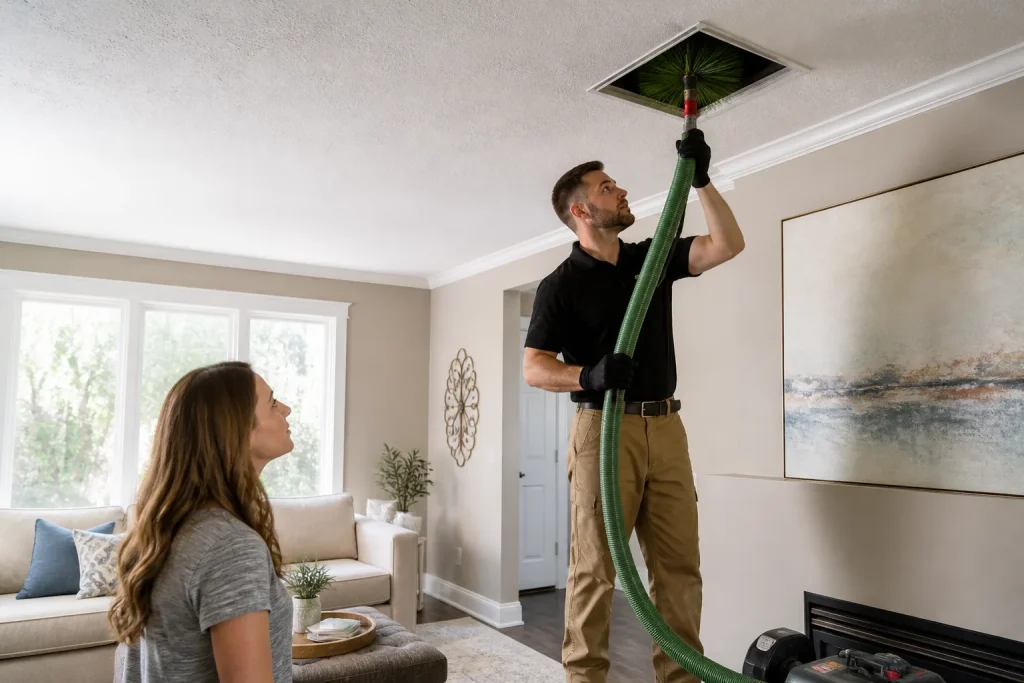
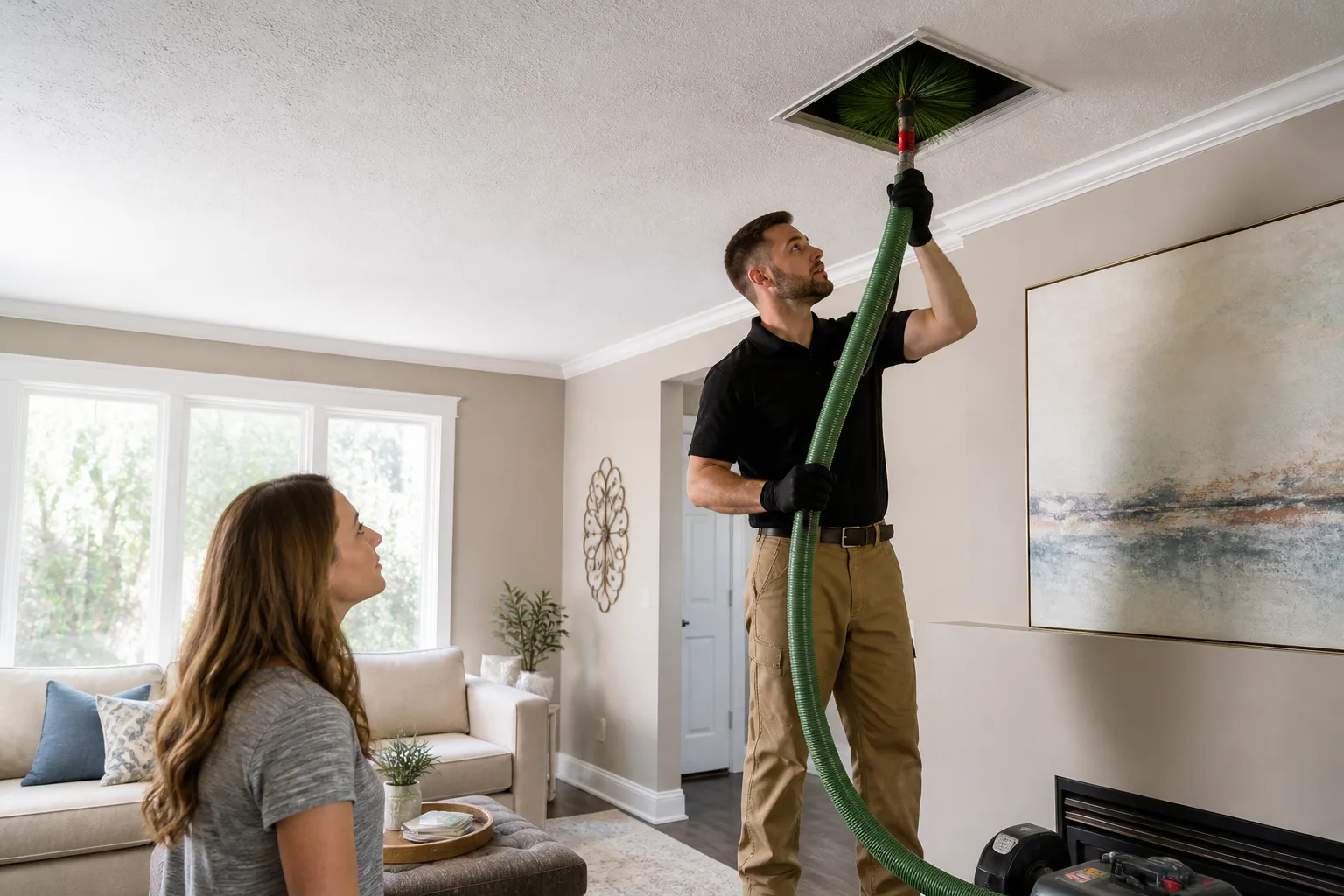
That matters because fine clay particulate doesn’t just accumulate. It compacts. A duct that looks only lightly coated can be nearly sealed at a bend or a takeoff because the layered deposit has packed into a hard film. Loose household dust is easy to move; compacted clay needs mechanical agitation, which is why we run contact-vacuum systems like Rotobrush and Nikro units on every job rather than relying on suction alone.
The dry air has a second effect. Low indoor humidity means more static charge on duct surfaces, and charged surfaces attract and hold fine particulate. A home in Lafayette can accumulate a heavier internal deposit than a similar home in a wetter climate, without showing more dust at the registers.
The seasonal dust storms and spring wind events in the area accelerate all of this. So does any period when windows are open more than usual. If your HVAC filter is loading up faster than it used to, that’s a signal worth reading alongside the others.
Cleaning Problem vs. Seal Problem vs. Liner Collapse
Not every sign points to cleaning. Three distinct problems produce overlapping symptoms, and confusing them wastes money. This is the part most articles skip.
- Contamination (needs cleaning): Visible buildup, musty odor, increased dust, allergy symptoms that worsen indoors. The ducts are structurally sound but dirty.
- Seal failure (needs repair and sealing): Whistling at joints, rooms that never heat or cool properly even after cleaning, dust streaks at seams, air escaping into crawlspaces or attics. The system is losing air before it reaches the register.
- Liner collapse (needs repair or replacement): Flexible ductwork that has sagged, kinked, or separated internally. You’ll see sudden dramatic airflow loss in one zone, sometimes with a rattle or a thud when the blower engages.
Cleaning a duct that has a seal failure fixes nothing, and sealing a duct with a collapsed liner doesn’t restore airflow. That’s why we inspect before we clean, and why duct repair and sealing is a core service for us rather than an upsell tacked onto the invoice. When we find a problem during cleaning, we can fix it on the same visit.
How Recent Renovation Changes the Timeline
Renovation resets the clock on duct contamination, and a minor renovation counts. Replacing flooring, patching drywall, painting, or opening a wall for electrical work all release fine particulate into the air that the return system pulls straight into the ductwork. Drywall dust, sawdust, and insulation fibers don’t just settle on the floor. They settle in the ducts, and they stay there long after the plastic sheeting comes down.
If you’ve done any work in the last year, treat your ducts as suspect regardless of when they were last cleaned. Even a single room’s worth of drywall repair can load return-side ductwork heavily, especially if the return register in that room stayed uncovered while the trades were working. The same applies after a pest issue, water intrusion, or a fire nearby that sends smoke through the neighborhood.
After renovation, a cleaning with a negative-air setup matters. We use Abatement Technologies negative-air machines to contain the dust we’re loosening so it doesn’t migrate back into the living space during the work. That’s the same containment standard used on abatement and restoration projects, and it’s the reason we don’t run a bare vacuum into a dirty duct and call it done.
When to Call a Pro
You can run the tissue test and pull your thermostat runtime log yourself. Those are homeowner-level tasks. Call a professional when the signs point somewhere you can’t see: suspected liner collapse, seal failures inside walls or crawlspaces, mold or pest contamination, or allergy symptoms that have gotten worse indoors without another explanation. Those need proper inspection and, in the case of contamination, remediation-grade equipment.
We answer 24/7. Fast dispatch from 7am to 7pm, Sunday through Friday. Our technicians have up to 12 years of experience, and we work with Honeywell and Aprilaire air-quality systems when the job calls for it. Every estimate is free, and we set one flat price for the whole system before work begins.
Related services in Lafayette: if the signs point to the whole system, start with air duct cleaning. If your dryer is taking two cycles to finish a load, that’s a separate and more urgent sign worth reading, so look at dryer vent cleaning. If the problem traces to a dirty coil or blower rather than the ducts themselves, HVAC cleaning covers that side of the system.
The Bottom Line
Visible dust is the last sign to arrive, not the first. The earlier signals live in your airflow, your cycling pattern, and your utility bill. Run the tissue test across your registers. Compare the readings. Check whether your system short-cycles in winter or runs long in summer. If the pattern holds, the ducts are worth a look before you spend money on equipment.
Lafayette’s semi-arid dust packs into ductwork more densely than typical household dust, so light-looking buildup can still mean restricted flow. And if you’ve renovated anything in the last year, treat your system as newly contaminated no matter when it was last cleaned.
- Airflow asymmetry between registers is a stronger signal than visible dust
- Short-cycling in winter and extended runtime in summer both point to restriction
- Cleaning, sealing, and liner repair are three different problems
- Recent renovation resets the contamination timeline
If you’re in Lafayette and need help, Lafayette Air Duct Cleaning Pros offers free estimates – call Lafayette Air Duct Cleaning Pros at (877) 792-6649.
Frequently Asked Questions
A filter change fixes the air handler side; it doesn’t fix restricted branch lines or contaminated duct walls. If you’ve replaced the filter and still see uneven airflow between registers, musty odor at startup, or a runtime pattern that’s drifting from normal, the ducts themselves need a look. Call (877) 792-6649 to book a free estimate.
Yes. Restricted supply airflow makes the thermostat satisfy quickly while far rooms stay cold, so the furnace cycles more than it should. The system is working correctly; the distribution network is fighting it. An inspection tells you whether cleaning or sealing is the answer. Call us for a free estimate.
There’s no single interval that fits every home. Climate, renovation history, pets, and filter habits all move the timeline. A home that’s had recent construction can need attention far sooner than one that hasn’t. If you’re unsure, a free estimate gives you a real answer instead of a generic one. Call (877) 792-6649.
Often yes, especially if drywall, flooring, or insulation work was involved and the return registers stayed uncovered. Fine particulate travels through the return system and settles throughout the ductwork, not just the room that was worked on. Our technicians have up to 12 years of experience reading this, and we’ll tell you honestly if a full cleaning isn’t needed.
Written by the team at Lafayette Air Duct Cleaning Pros.
Need Air Duct Cleaning Help?
Call Lafayette Air Duct Cleaning Pros - the local pro we connect you with is licensed and insured, with free written estimates in Lafayette.
(877) 792-6649